


Like us, the endangered ape notices inequity
Most humans would agree: it’s only fair for people to get equal rewards for putting in equal effort. Although many animal species are oblivious to such considerations, new research confirms that bonobos, like humans, care about fairness.
Studies of human reactions to inequity date back more than 60 years, when behavioral scientists began looking at how unequal treatment affects work performance. Interest in the topic rapidly expanded. Researchers soon documented that humans not only don’t like getting less than what they consider to be fair (so-called “disadvantageous inequity”) but they also often recoil from getting more than their fair share (“advantageous inequity.”)

Why Does a Sense of Fairness Develop?
At first glance, a sense of fairness in any species is puzzling. Why should a dislike of unequal treatment have evolved in humans or any other animals? A leading theory posits that cooperative actions can’t develop unless people feel their rewards for pitching in to a group effort will justify their efforts. The benefits of cooperating with those outside one’s kinship groups must “reach all contributing parties in roughly similar amounts,” primatologist Frans de Waal and evolutionary biologist Sarah Brosnan wrote.4
Individuals who get fewer benefits may stop participating and seek more equitable partners, thus potentially weakening the group. With enough cognitive ability and emotional control, an individual might develop an aversion to getting more than they’re due in order to prevent being ostracized.
Monkeys Also Disliked Unfairness
For millennia, people believed animals were devoid of any such feelings; Aristotle thought they had no sense of fairness because they lacked speech and rational thought. Then in 2003, de Waal and Brosnan devised an experiment using capuchin monkeys trained to hand back an object in return for a reward.
They placed pairs of such monkeys in side-by-side enclosures and rewarded them unequally (with a mundane piece of cucumber versus a succulent grape.) Videos of the reaction of the cucumber recipients make their outrage clear. To a statistically significant extent, the malcontents refused to participate in the experiment after researchers treated them unfairly.
After publication of that finding5 inequity aversion studies proliferated. Researchers tested many types of primates, as well as birds, rats, dogs, and other animals. Some of these efforts appeared to show positive results, while other studies failed to replicate Brosnan and de Waal’s capuchin results.
Critics also pointed out that maybe the animals who turned down lower-value treats weren’t focusing on fairness at all. Maybe they were just disappointed because they weren’t getting the tasty tidbits they expected. Or perhaps they were mad at the human experimenters for not giving them the best rewards.
Bonobos Reacted Differently Than Other Apes
A 2024 meta-analysis synthesized data from 23 studies of 18 non-human species. It found no evidence for inequity aversion in any of them.6 But only one of those studies included any bonobos (5 individuals) and their performance was co-mingled with that of 6 chimpanzees and 4 orangutans.
When a team in the Netherlands examined the data in that study and broke out the results for each species, they came to a different conclusion. They found that the bonobos had responded much more strongly to unequal rewards than the other great apes in the study.
Bonobos are highly social and engage almost nonstop in mutual grooming, sex, and other cooperative activities. Researchers theorized that bonobos should be strong candidates for disliking inequity. The Dutch team thus devised a study that would include only bonobos: three males and three females living at the Leipzig Zoo who ranged in age from 9 to 39.
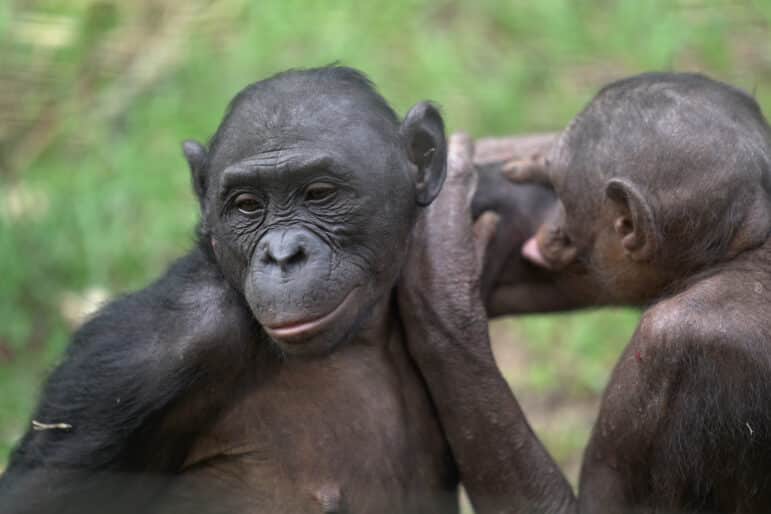
They designed the experiment to rule out any frustrated expectation or disappointment in the person doling out the treats. In one part of the trials, for example, treats were dispensed by a machine instead of a human.
The results, published in April 2025,7 showed the bonobos were three and a quarter times more likely to refuse to exchange tokens with the experimenters when they received a lesser reward than their peers. The reactions seemed to reflect “a genuine aversion to unequal treatment” rather than any disappointment with the humans, the lead researcher concluded.
Another interesting finding was that when the subjects were paired with a friend, i.e. an individual that they frequently groomed, they were more tolerant of inequity than otherwise. The Dutch study did not try to answer the question of whether bonobos have any aversion to being treated better than their fellows.
The Netherlands team found that the bonobos responded much more strongly to unequal rewards than the other great apes.
Research in this area on any animals is extremely limited. One 2010 study did find that chimpanzees were more likely to refuse a high-value grape when a companion got a lower-value carrot than when the other chimpanzee also received a grape.8However, other studies have not confirmed this. Only one research effort9has looked at bonobos’ reactions to unearned benefits, and it did not find that bonobos were bothered by it (but as in the Dutch study, they clearly disliked being given less.) Much more research will be required to fully understand this complex question.
- Geraci A, Surian L. 2011 The developmental roots of fairness: infants’ reactions to equal and unequal distributions of resources. Dev Sci 14, 1012-1020. (doi.org/10.1111/j.1467-7687. 2011.01048.x) ↩︎
- Blake PR et al. 2015 The ontogeny of fairness in seven societies. Nature 528, 258-261. (doi: 10.1038/nature15703) ↩︎
- Blake PR, McAuliffe K. 2010 “I had so much it didn’t seem fair”: Eight-year-olds reject two forms of inequity. Cognition 120:215-224. (doi.org/10.1016/j.cognition.2011.04.006) ↩︎
- Brosnan SF, de Waal FBM. 2014 Evolution of responses to (un)fairness. Science 346 (doi: 10.1126/science.1251776) ↩︎
- Brosnan SF, de Waal FBM. 2003 Monkeys reject equal pay. Nature 425, 297-299. (doi:10.1038/nature01963) ↩︎
- Ritov O, Völter CJ, Raihani NJ, Engelmann JM. 2024 No evidence for inequity aversion in non-human animals: a meta-analysis of accept/reject paradigms. Proc R Soc B (https://doi.org/10.1098/rspb.2024.1452) ↩︎
- Radovanović K et al. 2025 Bonobos respond aversively to unequal reward distributions. Proc R Soc B 292:20242873. (doi.org/10.1098/rspb.2024.2873) ↩︎
- Brosnan SF, Talbot C, Ahlgren M, Lambeth SP, Schapiro SJ. 2010 Mechanisms underlying responses to inequitable outcomes in chimpanzees, Pan troglodytes. Anim Behav 9:1229-1237. (https://doi.org/10.1016/j.anbehav.2010.02.019 Epub 2010 Mar 25. PMID: 27011389; PMCID: PMC4801319) ↩︎
- Verspeek J, Stevens JMG. 2023 Behavioral and physiological response to inequity in bonobos (Pan paniscus). Am J Primatol 85 e23455 (doi:10.1002/ajp.23455) ↩︎
Jeannette De Wyze was a journalist at the San Diego Reader for 30 years. Today she’s a bonobo lover and supporter and the volunteer liaison between Women’s Empowerment International and the Nyaka Grannies Project in Uganda. She also raises puppies to be service dogs for Canine Companions for Independence and is an active travel blogger.