


New research at Lola ya Bonobo investigates how bonobo behaviors spread through a bonobo community.
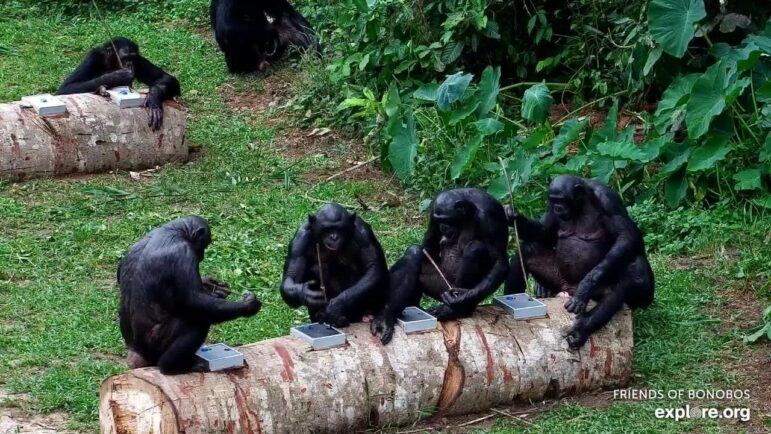
What would you do if you couldn’t solve a puzzle? One bonobo at Lola ya Bonobo had an out-of-the-box solution. After repeatedly failing to open a puzzle box armed with a locking mechanism, she picked up a large branch and smashed the puzzle open revealing a peanut butter reward.
It wasn’t the solution researchers had designed. But it worked. And she enjoyed the delicious peanut butter.
Moments like this are exactly what researchers have been watching for at Lola as they investigate one of the most intriguing questions: Can a new behavior discovered by one individual spread through an entire group? And could this be how bonobo culture is created?
Culture, as defined by UNESCO, means the shared beliefs, values, customs, behaviors, and everyday practices that characterize a group of people. While this definition is specific to humans, culture has more broadly been defined as, “the sum of all behaviors and knowledge that are acquired and passed on between and within generations through forms of social learning’ (Brakes et al., 2021).
What about culture within bonobo groups?
The team of researchers at Lola this year is looking at how a behavior first discovered by one individual can spread throughout a group, become shared by others, and perhaps lay the foundation for a new tradition.
To hear more about this exciting study, we interviewed researcher, Lou Savigny.
Can you briefly explain what your research is about?
We are looking at how bonobos learn new behaviors and whether they learn from watching one another, a behavior called peering.
How are you investigating this topic of culture and learned social behavior?
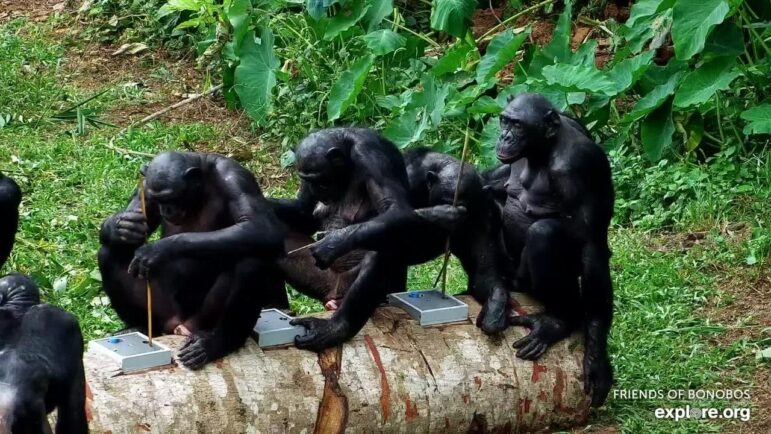
To explore these questions, we give the bonobos a fun but challenging problem to solve using specially designed “puzzle logs.” Earlier research at Lola ya Bonobo showed that bonobos can learn to use sticks to reach food hidden inside holes—much like tool use we see in wild chimpanzees when they fish for termites or extract honey.
Now we’re making the puzzles a little harder. Before they can use the stick, bonobos first have to figure out how to unlock a small compartment hiding the food. Some puzzles require them to slide a knob, others to rotate it, and eventually they must combine both steps.
What makes this especially exciting is that we’re not just interested in whether a bonobo can solve the puzzle. We want to see how they figure it out—and how they learn from each other. By watching who explores, who observes, who discovers a new solution, and whether others begin to copy it, we can learn more about how new behaviours emerge and spread through bonobo communities.
What do puzzle logs teach us about bonobo intelligence?
The puzzle logs allow us to explore aspects of bonobo social cognition—how bonobos solve new problems, use tools, learn, and make use of information available in their social environment.
The study highlights their behavioural flexibility when faced with a novel, multi-step foraging challenge, but more importantly, investigates social learning. We hope to better understand whether and how bonobos learn from one another, how features of their social system—such as female alliances—influence these learning processes, and how new behaviours may eventually become shared within a group.
Ultimately, this will help us better understand the socio-cognitive foundations that support social learning and may contribute to cultural transmission in one of our closest living relatives.
What questions are you specifically trying to answer through this research?
Our main questions are:
• Do bonobos acquire these new behaviors predominantly through individual exploration, or social learning?
• If social learning occurs, what are the pathways involved? For example, does close observation (peering) facilitate learning?
• Which individuals are most likely to learn from whom? Do bonobos preferentially observe close social partners, high-ranking individuals, or skilled individuals?
• As tasks become more challenging, do bonobos rely more on social information?
• Does previous experience with simpler behaviors help bonobos solve a more complex task that combines those behaviours?
What did bonobos need to do to figure the puzzles out?
During Phase 1, bonobos are presented with two different puzzle logs simultaneously, each of them containing 4 identical puzzles.
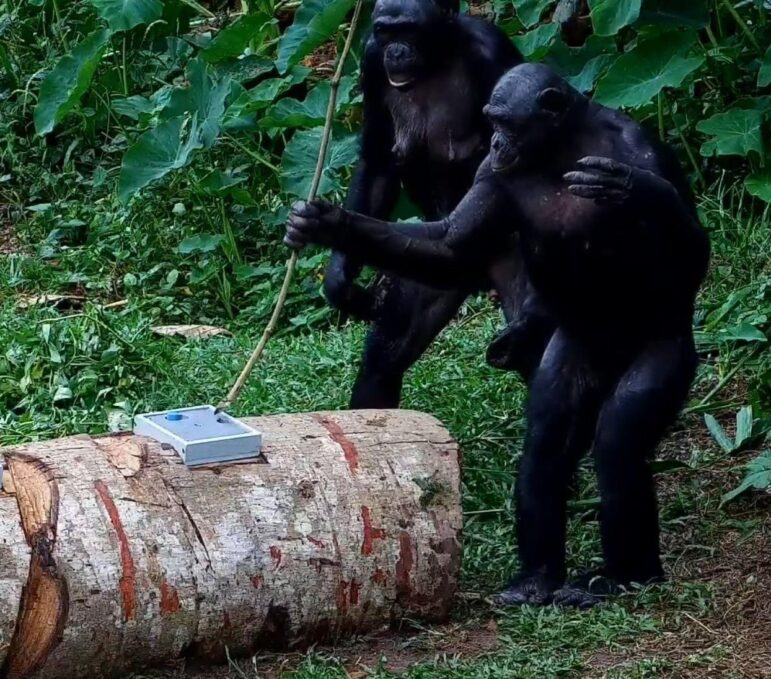
On the first log, they must slide a knob sideways and hold it while inserting a stick to retrieve the food reward. On the second log, they must rotate a knob, hold it open, and then use the stick.
During Phase 2, the challenge becomes more complex. Bonobos must first slide one knob, then rotate a second one, before finally using a stick to access the reward.
This allows us to investigate whether previously acquired behaviors during phase 1 can be combined to solve a novel, more complex problem.
How long did it take the bonobos to figure out the puzzles?
The timing varied between groups and individuals. In one of the study groups, the first successful solution to the sliding puzzle was observed on the very first day of testing, while the rotating puzzle was first solved on the third day. Since then, more individuals have gradually acquired both techniques.
What types of food or treats are hidden inside?
Locally made peanut butter mixed with a small amount of sunflower oil.
Do different bonobos solve the puzzles in different ways?
Yes. Although the required behavioural sequence is the same, individuals develop slightly different techniques. For example, some bonobos hold the locking mechanism open with one hand, while others open the knob with one hand but then hold it with their foot.
Have you noticed differences between younger and older bonobos? Between males and females?
These are questions we will formally investigate once the study is complete. So far, more females have acquired the different techniques. We don’t know (yet) if this pattern reflects differences in females’ learning abilities, differences in access to the puzzle logs due to the bonobo social system or simply differences in group sex ratios. To be explored!
We are also interested in the role of previous experience with the stick-use behavior. Some younger bonobos were not yet integrated into their social groups during the earlier tree log study, while others have this experience. The puzzles appear more challenging for individuals without this previous knowledge, so we are interested in whether earlier exposure to the stick-use behavior influences how readily bonobos acquire the new behavioral sequences.
Do you have a favorite moment from watching the bonobos?
One female struggled with the rotating puzzle for several days. Then, one morning, she spent a long time closely watching skilled individuals interacting with the puzzles. Later that same day, she successfully solved it herself for the first time. Whether this event reflects social learning is exactly what our analyses aim to determine, so we cannot draw conclusions from a single observation. Nevertheless, it was a fascinating moment to witness.
Does what you learn here have implications for protecting bonobos in the wild?
From a broader perspective, yes. Scholars increasingly recognize that conserving endangered species is not only about protecting individuals and populations, but also about preserving their behavioral diversity. Socially learned behaviors and cultures are increasingly viewed as an important part of a species’ behavioral repertoire and heritage. Because cultural transmission can occur much faster than genetic evolution, socially-transmitted behaviors can enable populations to respond more rapidly to fast-changing environments.
By improving our understanding of the learning processes that give rise to these behaviors, our study may help identify cultures in wild bonobo populations and ultimately inform conservation strategies.
– Lou Savigny, Researcher
Below you will see the bonobos exploring the puzzle logs!

Meet the Researchers:
This research is being carried out by PhD student Lou Savigny, who was accompanied at Lola ya Bonobo by masters student, Lola Lemaire, and research assistant, Zoé Danis. The puzzles were designed by research technician, Sebastian Schütte from the MPI for Evolutionary Anthropology. This project is supervised by Dr Edwin van Leeuwen, in conjunction with the ‘Animal Behaviour and Cognition’ group at Utrecht University (Netherlands), as part of a team of researchers investigating culture in multiple species of non-human primates.
A note from the researchers:
“Our heartfelt thanks go to all the staff at Lola ya Bonobo, without whom the installation of the logs and the observations we carried out would not have been possible.”
Citations:
Brakes P et al. 2021 A deepening understanding of animal culture suggests lessons for conservation. Proc. R. Soc. B 288: 20202718
——-